
I had been due to play at RACV Healesville on Monday afternoon with David. Quantas had put a stop to that. Happily, however, David was able to play on Tuesday afternoon, too. After a very pleasant lunch at Kingston Heath I set off to the town (village?) of Healesville, in the Yarra Valley. The Yarra Valley is one of Australia’s better known wine regions and the drive was, towards the end, punctuated by passing well advertised wineries. The area was hilly, as most wine regions are, and very green. Really a very attractive area.
RACV are the initials of the Royal Automobile Club of Victoria. Rather like the British RAC they have made very significant money from roadside assistance and insurance. Unlike the UK RAC these profits have accrued to what is Australia’s wealthiest private members club. The club has a number of sites with, effectively country club facilities, as well as a property in Melbourne. At Healesville the country club has a very modern building and a golf course that was recently extensively remodelled by Mike Clayton, who is also doing the renovation at Bonnie Doon. The course is interesting and controversial in golf architecture circles. At 4800 metres (5300 yards) and a par of 66 it is very short by modern standards. It also features some substantial elevation changes and has some dramatic greens.
I had read that there were conditioning issues at Healesville and that the course can be wet, so that it really plays best in the summer and autumn, rather than the spring (which it is now). On arrival I met David and the first thing he did was apologise for the condition of the course. Indeed, the first fairway (which I managed to avoid making any real use of, anyway) was a real mess, a mixture of grasses and mud patches. David explained, as we played, that the superintendant (head greenkeeper) had attempted to change the grass on the fairways from that seeded by Clayton to couch, a variety commonly used in Melbourne (indeed, Kingston Heath has couch fairways). Melbourne is much warmer and drier than Healesville, however, and the couch grass was not growing well.
The conditioning issues are a real shame for what should be an important golf course. In an era where there is a mad race to longer and longer courses, the construction of a 5300 yard course is a brave move. Long courses use more land, require more mowing, more irrigation, more upkeep generally and take longer to play than short ones. Cost and the time it takes to play are major disincentives to players taking up the game and of players not playing as much as they might (or, perhaps, at all). Healesville didn’t actually feel that short. There are more par 3s than usual, which helps and the par 5s are not long. The soft fairways will also have made it feel a bit longer than it would when dry. The main interest, however, comes from the dramatically contoured greens: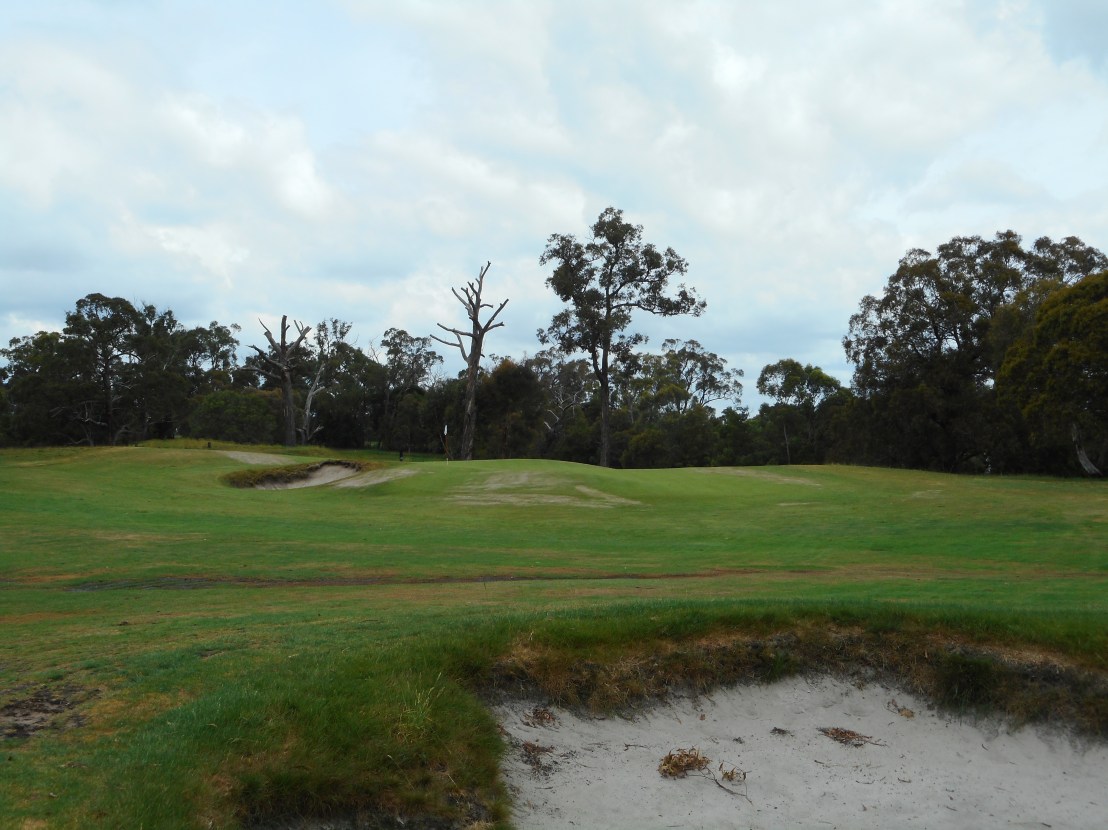
These are also where the conditioning is the biggest issue. If firm and reasonably paced, these greens would be not only really challenging to chip to and putt on but would also be great fun. The softness and relative slowness of them removed much of that interest, though not all.
I’d love to see Healesville in really good nick, it would be a blast to play.
After a quick beer at the club, David and I headed back to Melbourne, stoppng on the way for a bite to eat at a local brewery. Like Tasmania it seems that wineries, breweries and distilleries all coexist in the same areas.
 A Golfing Sabbatical in Australia